
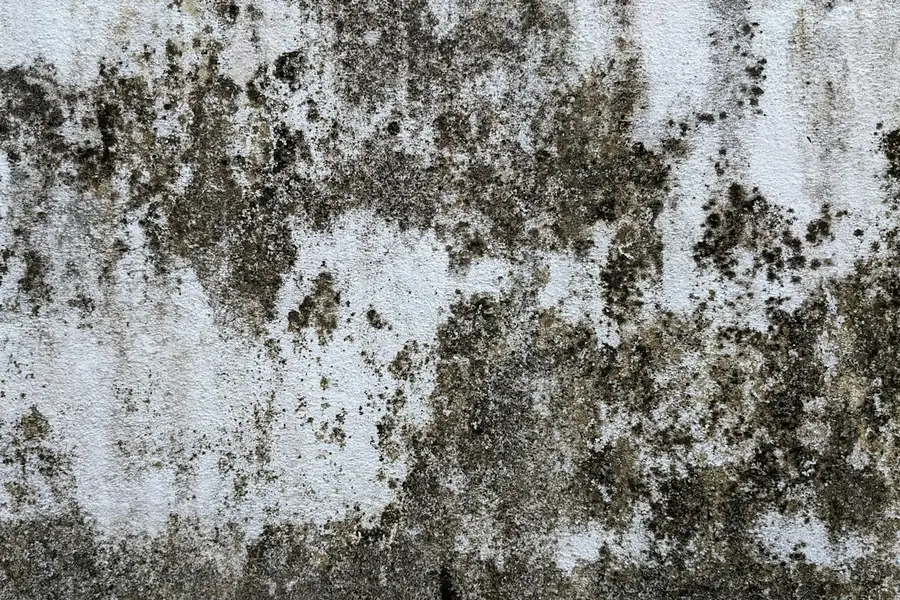
Condensation
& Black Mould
Mould is a symptom. Wiping it off treats the symptom. We establish why that surface is cold enough or wet enough to grow mould in the first place, and deal with that instead.
Why Mould Grows
Mould needs three things: spores, which are present in every building everywhere; food, which is the dust, paint and paper on almost any surface; and moisture. You cannot remove the first two. The whole job, therefore, is moisture — specifically, why a particular surface stays wet for long enough and often enough to let a colony establish.
In London housing there are four usual answers, and they need four different responses:
- Surface condensation. Warm, moist internal air meeting a cold surface. Classic pattern: black spotted mould in room corners, behind wardrobes, around window reveals and on north-facing external walls, worse from October to March.
- Cold bridging. A localised part of the structure that conducts heat out much faster than the surrounding fabric — a concrete lintel, an un-insulated reveal, a steel, a balcony slab or the junction where an extension meets the original building. Mould appears in a sharp, oddly geometric pattern that mirrors the structure behind.
- Inadequate ventilation. Moisture generated by cooking, washing, drying clothes and simply breathing has nowhere to go. Sealed trickle vents, an extract fan that runs but moves no air, a blocked airbrick, or a bathroom fan ducted into a loft rather than outside.
- An underlying damp defect. Penetrating damp, a plumbing leak, rising damp or a failed below-ground waterproofing system keeping fabric wet, with mould as the visible consequence.
Why "just get a dehumidifier" often fails
A dehumidifier lowers the moisture content of the air in the room it is standing in. If the problem is a cold bridge at a lintel, or an extract fan ducted into a loft, or a leaking rainwater pipe soaking a wall, it will make a marginal difference at best while the actual defect continues. It is a useful tool during a drying-out period, and a poor substitute for a diagnosis.
How We Diagnose It
A condensation and mould survey looks at the building and the way it is used together. We record internal temperature and relative humidity, take surface temperature readings at the affected areas, use thermal imaging to map cold bridging and missing insulation, measure extract fan performance rather than just confirming that the fan spins, check trickle vents and airbricks, and take moisture readings to rule in or rule out a fabric defect behind the visible mould.
The report tells you which of the four causes above you have, in what proportion, and what it takes to fix. If the answer is partly behavioural — drying washing on radiators in a sealed flat is a genuinely large moisture load — we will say so, but we will not stop there, because "it is the tenant's lifestyle" is not a diagnosis and it is not a defence.
What We Install
| Measure | Addresses |
|---|---|
| PIV unit | Whole-property humidity; continuous low-level fresh air supply from a loft-mounted unit |
| dMEV extract fans | Continuous low-rate extraction in kitchens and bathrooms, boosting on humidity |
| Humidity-sensing extract | Bathrooms where an existing fan is undersized, badly ducted or ineffective |
| Insulated reveals & thermal board | Localised cold bridging at lintels, reveals and structural junctions |
| Anti-mould coating systems | Post-treatment protection on surfaces that remain higher risk |
| Airbrick & sub-floor ventilation | Damp, poorly ventilated suspended timber floors |
Mould Removal Itself
We remove mould with a biocidal treatment that kills the colony rather than a bleach wipe that removes the colour and leaves the growth. Heavily affected plaster or plasterboard is cut out and replaced where the contamination has gone beyond the surface. Affected areas are then made good and, where appropriate, finished with an anti-mould coating. None of this is worth doing until the moisture cause has been dealt with — mould that returns within a winter means the diagnosis was wrong.
For Landlords, Agents and Housing Providers
Damp and mould in rented housing is now a legal exposure as well as a repair item. The Homes (Fitness for Human Habitation) Act 2018, the Housing Health and Safety Rating System hazard framework and — for social housing — the strict investigation and repair timescales introduced by Awaab's Law (brought in under the Social Housing (Regulation) Act 2023) mean you need evidence of what you found, when you found it and what you did.
The Department of Health and Social Care and MHCLG publish government guidance for rented housing providers, which sets out why damp and mould should not be treated as a lifestyle issue. It is worth reading before responding to a tenant complaint.
We provide surveys written for that purpose: a dated record of conditions, measured readings, photographs, an assessment of the hazard, and a clear remedial specification with timescales. We can attend with proper notice, work around tenants, and report to the agent, the landlord or both.
Condensation & MouldFAQs
Living with mould increases the risk of respiratory infections, allergic reactions and asthma, and the risk is higher for infants, older people and anyone with an existing respiratory or immune condition — see the NHS guidance on damp and mould. It is treated seriously in law for exactly that reason. It is not something to live with over a winter while you decide what to do — if there is mould in a bedroom used by a child or someone with a respiratory condition, treat it as urgent and call us on 0207 126 8487.
Often, and it is one of the most cost-effective single measures for a whole property with general high humidity. It is not a universal fix. A PIV unit does very little about a sharply defined cold bridge at a concrete lintel, and nothing at all about a leaking gutter soaking an external wall. We recommend one where the survey supports it, which is frequently but not always.
Painting over live mould, even with an anti-mould paint, hides it for a few months at most. The growth continues under the coating, the moisture source is untouched, and you end up stripping more material later than you would have done. Anti-mould coatings have a genuine role — but as the last step after the cause is fixed and the contamination removed, not as the first and only step.
Usually both, in some proportion — and that proportion is measurable rather than a matter of opinion. A survey establishes the surface temperatures, the ventilation performance and the moisture loading, and separates what the fabric is responsible for from what occupancy is contributing. That gives you a defensible position and a remedial specification rather than an argument, which is generally what both parties actually want.

Get the Cause Found & Fixed
Book a survey and you get a written report: what is causing the damp, what it takes to fix it and what it costs. No pressure, no guesswork.
Survey fee deducted from the cost of works if you proceed